New paper: The remnants of the first stars

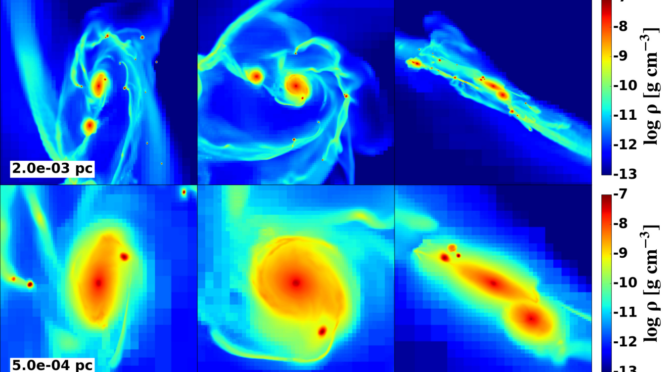
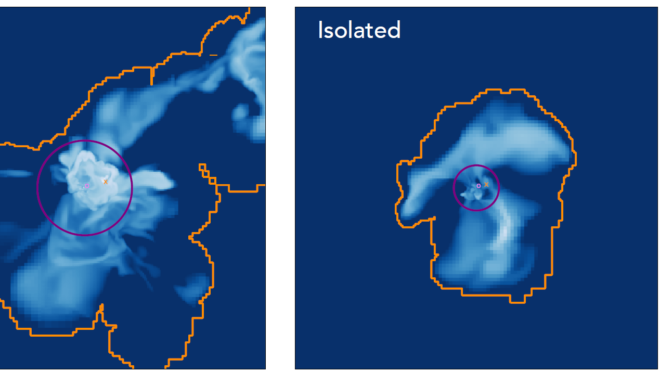
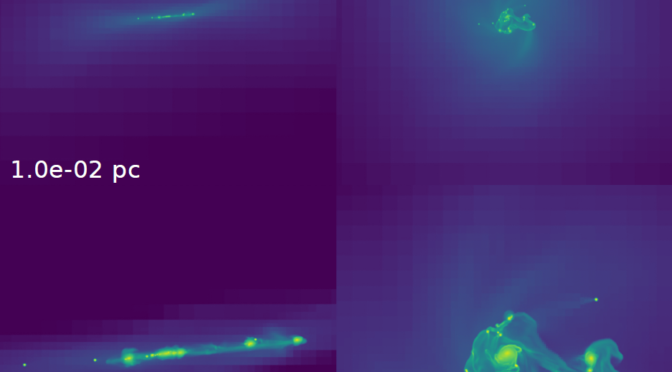
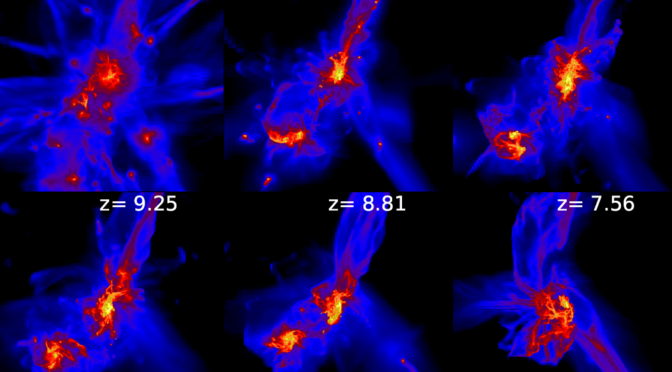
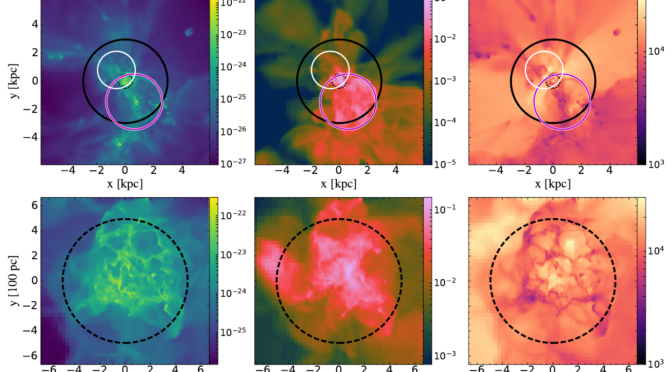
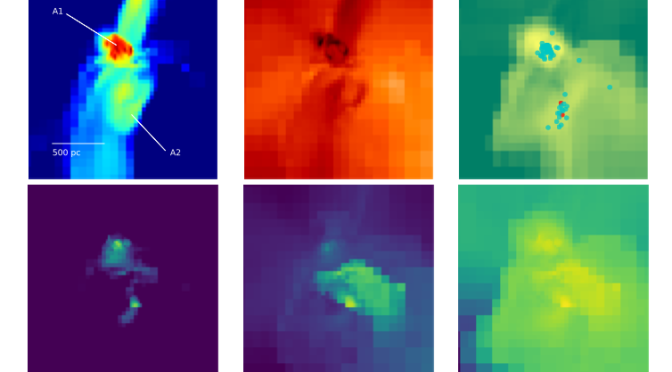
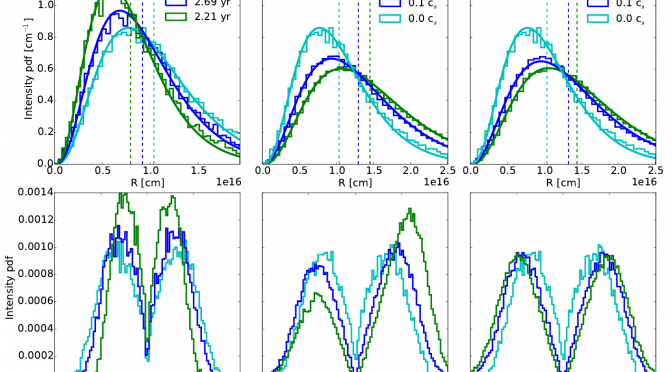
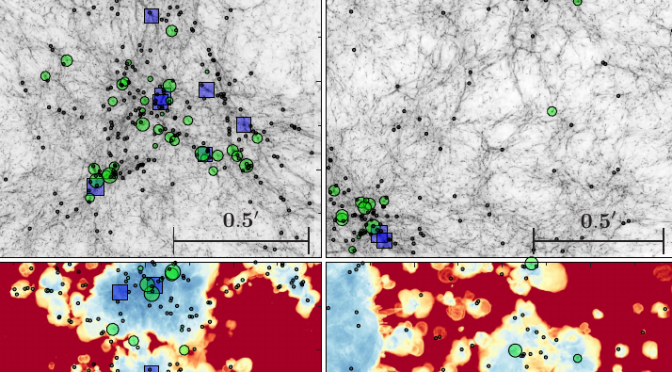
There is building evidence that the first stars are not as massive as previously thought and that they are merely typical massive stars on the order of tens of solar masses instead of behemoths up to 300 solar masses.  Furthermore, a non-negligible fraction of this population form in binary systems. These stellar systems can leave behind stellar-mass black holes, chemically enriched regions from their supernovae, and X-ray binaries if the companion star overflows onto the black hole during its giant phase. All of this depends on the initial mass function of the first stars, which is highly uncertain at the moment, but luckily it’s an active area of research!

To determine the evolution and impact of these remnants, we must know where they migrate after their progenitor star dies.  This week, Hao Xu, Michael Norman at UCSD and I submitted a paper that focuses on exactly this point. Continue reading

Optimized Multi-Frequency Spectra

Last week, we submitted a paper titled “Optimized Multi-Frequency Spectra for Applications in Radiative Feedback and Cosmological Reionization” to the Astrophysical Journal.  You can find it on arXiv.  Here we investigate the impact of varying energy discretizations in radiation transport schemes.  Mono-chromatic approximations can underestimate the amount of partial ionization at large radii because all of the ionizing photons are absorbed at some characteristic radius.  This is especially true for X-rays, which have large mean free paths.

With a multi-frequency approach, the solution converges with 4 or more frequency bins. For example with a 10^5 K blackbody source, the temperature of an HII region at r = 8 kpc is underestimated by a factor of 20 if a mono-chromatic spectrum is used.  However it is unclear the best technique on how to choose these frequencies.  In this work, we developed a Monte Carlo scheme to determine optimal frequency values for such radiation calculations.  In the paper, we give optimal discretizations for a 10^5 K blackbody and power law spectrum for 1-4 bins.  The code that employs this method will be released when the paper is accepted.

Visualization Lab Construction Started

After months of planning, the construction of our visualization lab started on Monday. Already, I am impressed with the speed of their work in renovating the space that was a classroom.  Hopefully we can have the equipment installed by the end of the month.  Then we’ll start working on setting up the computers that drive the stereoscopic projection wall and monitor wall, ready for science by the end of the semester.  I plan to publish a few posts that outline the build process of the lab.

WREK Interview

A few weeks ago, I was interviewed by Charlie Bennett, who runs the North Avenue Lounge show on Georgia Tech’s student radio station.  I had a great time during the show. We chatted about my homecoming to Georgia Tech, my research, and the construction of the visualization lab for our group.  The show will be streaming until March 5th, so go listen!

“The Birth of a Galaxy” Published

High-z dwarf galaxy

High-redshift disk dwarf galaxy

In late November, our paper, “The Birth of a Galaxy: Primordial Metal Enrichment and Stellar Populations”, was accepted for publication in The Astrophysical Journal. It was recently published in the January 20th issue.

In this paper, we followed the formation of over 300 Population III (metal-free) stars and accurately modeled the radiative feedback from their main sequence and studied the chemical enrichment from their supernovae. Our methods allowed us to follow a natural transition from Population III to Population II star formation, leading to the formation of 38 high-redshift dwarf galaxies with the most massive having M = 109 solar masses. We found that they produce a metallicity floor of 10-3 of solar metallicity in the vicinity (5-10 kpc) of their host halos. At redshift 7, about 14% of the cosmic mass is enriched above 10-6 of solar metallicity. This gives some clues on the origin of an observed metallicity floor of 10-3 in damped Lyman alpha absorbers.

New members and computer update

We have four new members to our group, starting in the Spring semester.  Chao Shi, a second-year graduate student, will be focusing on black hole growth from both stellar-sized and massive seeds.  Three undergraduate students, Erin Caldwell, Vasiliy Demchenko, and Martin Halicek, will be joining the group, obtaining valuable experience in astrophysics research and learning about various topics in high-redshift galaxy formation.

In other news, our cluster arrived in Georgia Tech a couple of weeks ago, and the IT guys are configuring it right now.  It’ll be ready and stress-tested by the new year. Then it’ll get some stress-testing from myself!

Computer Cluster Ordered

Last week, I got word that the 16-core processors were available for order from our supplier.  I placed an order for our dedicated cluster that will be composed of

  • 8 nodes each with 64 cores and 256GB of RAM
  • A total of 512 cores and 2TB of RAM
  • QDR Infiniband interconnect
  • 48TB of long-term storage space.  Scratch space is 250TB.  It is shared among other clusters and connected by Infiniband.
The cluster should arrive in about a month and be tested and ready for science in December or January.  There are plans to expand the cluster to have Tesla GPU systems. It will be a very useful resource for rapid development and science once it become online. I’m very excited about it!